
Blood Donation and the LGBTQ+ Community: What You Need to Know
Blood Donation is More Inclusive than Ever
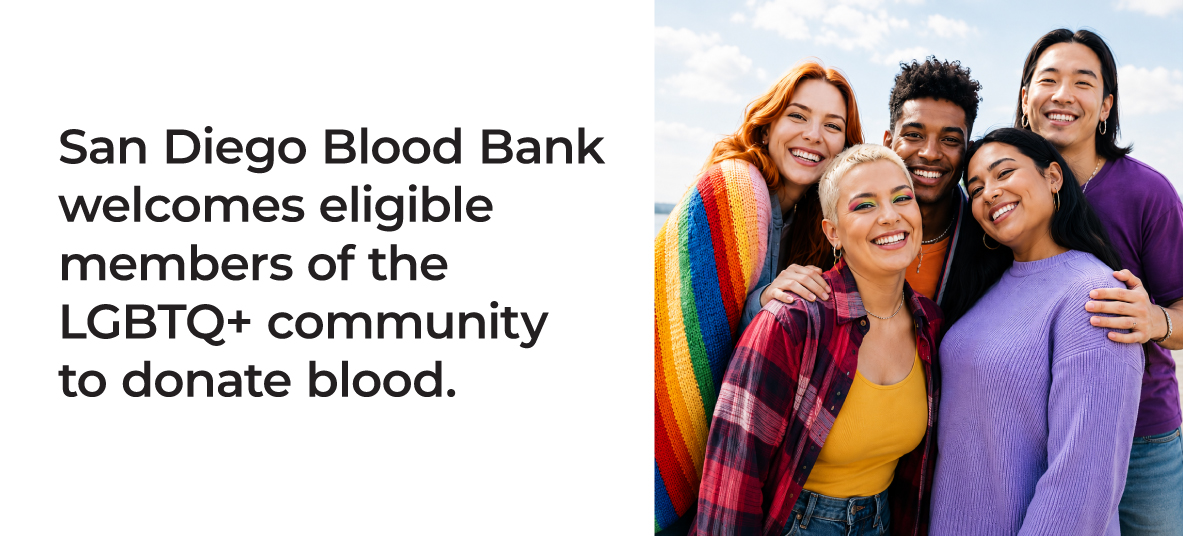
At San Diego Blood Bank, we believe everyone who is eligible to donate blood should have the opportunity to help save lives.
In 2023, the U.S. Food and Drug Administration (FDA) implemented significant changes to blood donor eligibility guidelines, replacing policies that considered sexual orientation with a science-based, individualized risk assessment process for all donors. These changes have made blood donation more inclusive while maintaining the high standards of blood safety required by the FDA for patients who depend on lifesaving transfusions every day.
Today, eligibility is based on individual risk factors—not sexual orientation, gender identity, or relationship status.
As a result, many members of the LGBTQ+ community who were previously unable to donate blood may now be eligible to become blood donors and help support patients throughout San Diego County and beyond.
A Brief History of Blood Donation Eligibility
For decades, blood donation policies in the United States included restrictions that specifically affected gay and bisexual men. These policies were originally implemented during the HIV/AIDS epidemic when testing technology and scientific understanding were far more limited than they are today.
Over time, advances in testing, blood safety protocols, and scientific research led to gradual changes in donor eligibility requirements. In May 2023, the FDA issued updated guidance that shifted the focus away from sexual orientation and toward individual behaviors that may increase the risk of recently acquired infections. Blood collection organizations across the country, including San Diego Blood Bank, adopted these changes to create a more equitable and evidence-based donor screening process.
What Changed?
This updated approach helps expand the donor pool while continuing to protect recipients who rely on blood transfusions.
Previous Policy
Under earlier guidelines:
- Eligibility questions included considerations based on gender and sexual orientation.
- Many gay and bisexual men were deferred from donating blood regardless of their individual circumstances.
- Restrictions often prevented otherwise healthy individuals from contributing to the blood supply.
Current Policy
Today:
- Every donor answers the same eligibility questions.
- Every donor receives the same screening process.
- Eligibility is determined using an individual donor assessment.
- Sexual orientation and gender identity alone do not determine eligibility.
- Risk is evaluated based on recent behaviors associated with the potential transmission of HIV and other infectious diseases.
What Hasn’t Changed?
While eligibility guidelines have evolved, one thing remains constant: Patient Safety Comes First
Every donation still undergoes rigorous testing and screening before it can be used for transfusion. The FDA continues to require extensive safeguards, including
✔ Confidential health history screening
✔ Donor eligibility assessment
✔ Laboratory testing for infectious diseases
✔ Strict collection and processing standards
✔ Ongoing monitoring and quality assurance
Each donated unit of blood is tested for HIV, hepatitis B, hepatitis C, and other transfusion-transmissible infections before being released for patient use. These multiple layers of protection help ensure one of the safest blood supplies in the world.
Understanding the Individual Donor Assessment
One of the most common questions people ask is: “How does eligibility work now?”
All blood donors—regardless of gender or sexual orientation—are asked the same questions.
Donors will be asked whether they have:
- Had a new sexual partner in the past three months, and/or
- Had multiple sexual partners in the past three months
If the answer is yes to either question, donors will then be asked whether they have had anal sex with any of those partners during the same time period.
If the answer is YES
The donor will need to wait three months from their most recent anal sexual contact before donating blood.
If the answer is NO
The donor can continue through the screening process and may be eligible to donate if all other criteria are met.
What if I have one partner?
If you have had only one sexual partner and have been in that relationship for at least three months, you will not be asked about anal sex and may be eligible to donate if you meet all other requirements.
This policy applies equally to everyone and is designed to identify recent risks of infection rather than focusing on a person’s identity or orientation.
Note:
Per the FDA-recognized AABB Donor History Questionnaire, any donor who has had sexual contact within the past 3 months with an individual known to have ever tested positive for HIV infection is deferred for 3 months from the date of last sexual contact. There are no exceptions to this criterion based on factors such as viral suppression or an undetectable HIV viral load.
Why Does the FDA Ask About Anal Sex?
Some people wonder why anal sex remains part of the screening process.
The reason is scientific.
Research has consistently shown that anal sex carries a statistically higher likelihood of HIV transmission per sexual encounter compared to vaginal or oral sex. Because blood donation safety relies heavily on identifying recently acquired infections, asking about anal sex in the context of new or multiple recent partners helps blood collection organizations more accurately assess risk.
It is important to understand that:
- The question is not about sexual orientation.
- The question is not a judgment about personal behavior.
- The question is based on evidence used to protect blood recipients.
The goal is to identify situations where an infection may have been acquired so recently that testing may not yet detect it.
What About PrEP and PEP?
Many people in the LGBTQ+ community use HIV prevention medications such as:
PrEP (Pre-Exposure Prophylaxis)
Medication taken to prevent HIV infection before exposure.
PEP (Post-Exposure Prophylaxis)
Medication taken after a possible HIV exposure.
These medications are highly effective and play an important role in HIV prevention.
However, because PrEP and PEP may affect how HIV appears during testing, the FDA currently requires temporary waiting periods for donors who use these medications.
Current Deferral Periods
Oral PrEP or PEP
- Three-month deferral from the most recent use
Injectable PrEP
- Two-year deferral from the most recent injection
These requirements are based on current scientific understanding and may evolve as additional research becomes available.
LGBTQ+ Donor Frequently Asked Questions
Can gay men donate blood?
Yes. Many gay men are now eligible to donate under the FDA’s individual donor assessment process.
Eligibility depends on recent risk factors rather than sexual orientation.
Can bisexual men donate blood?
Yes. Eligibility is determined using the same criteria applied to all donors.
Can women who have sex with women donate blood?
Yes. There is no deferral for a woman who has had sex with another woman.
Can transgender individuals donate blood?
Yes.
There is no deferral associated with being transgender. Eligibility is based on the gender the donor reports and any donation requirements associated with that gender, such as iron levels or donation-volume calculations.
Donors do not need to disclose that they are transgender to staff.
What about non-binary, gender-fluid, genderqueer, agender, or gender non-conforming donors?
Current FDA guidance requires blood donors to select either male or female on the donor history questionnaire.
San Diego Blood Bank recognizes that gender identity exists beyond a binary framework and continues to follow FDA requirements while treating all donors with dignity and respect.
What about intersex donors?
Intersex donors are not required to disclose that they are intersex. San Diego Blood Bank is committed to providing a respectful and welcoming experience for all donors. We currently ask donors to select a gender designation during registration because certain aspects of the donation process—including hemoglobin qualification and blood volume calculations for some collection procedures – continue to rely on gender-specific criteria. This information is used solely to help ensure donor safety and determine eligibility for specific donation procedures. Our screening for HIV-related risk is based on individual behaviors, not sexual orientation or gender identity.
What Should I Expect When I Donate?
The donation experience is the same for everyone.
Every donor completes:
- Registration
- A confidential health history questionnaire
- A brief health screening
- The donation process itself
Questions focus on factors that may affect donation safety and are asked confidentially.
San Diego Blood Bank is committed to creating an environment where all donors are treated fairly, respectfully, and professionally.
Why Blood Donations Matter
Every two seconds, someone in the United States needs blood.
A single blood donation can help save up to three lives.
Patients in our community depend on blood transfusions every day for:
- Cancer treatment
- Trauma and emergency care
- Major surgeries
- Childbirth complications
- Organ transplants
- Blood disorders, including sickle cell disease
- Chronic illnesses requiring ongoing transfusions
When more people are eligible to donate, more lives can be saved.
The FDA’s updated guidance helps ensure that lifesaving blood remains available for patients while maintaining the high standards of blood safety that healthcare providers and patients rely upon.

Friends Ella and Kamila share the same diagnosis—Beta Thalassemia Major—a rare form of anemia. Each of them received their first blood transfusion during the first few months of life and and they will continue to need them every 2-4 weeks for the rest of their lives. Thanks to blood donors, Ella and Kamila receive the life-saving care they need so they can thrive and enjoy memories with the ones they love.
San Diego Blood Bank Welcomes LGBTQ+ Donors
San Diego Blood Bank is committed to treating every donor and potential donor with fairness, equality, dignity, and respect.
We are proud to welcome more members of the LGBTQ+ community into our lifesaving donor family and grateful for everyone who chooses to share the gift of life through blood donation.
Whether you are a first-time donor or someone who has waited years for the opportunity to become eligible, we thank you for considering blood donation.
Together, we can ensure patients throughout Southern California have access to the blood products they need when they need them most.
Questions About Eligibility?
Our Donor Services team is here to help.
📞 (619) 400-8251
🌐 SanDiegoBloodBank.org
Ready to Save Lives?
Schedule your appointment today and become part of a community dedicated to helping patients, supporting families, and strengthening our region’s blood supply.
 (619) 400-8251
 SanDiegoBloodBank.org/donate
Your donation can make a difference.